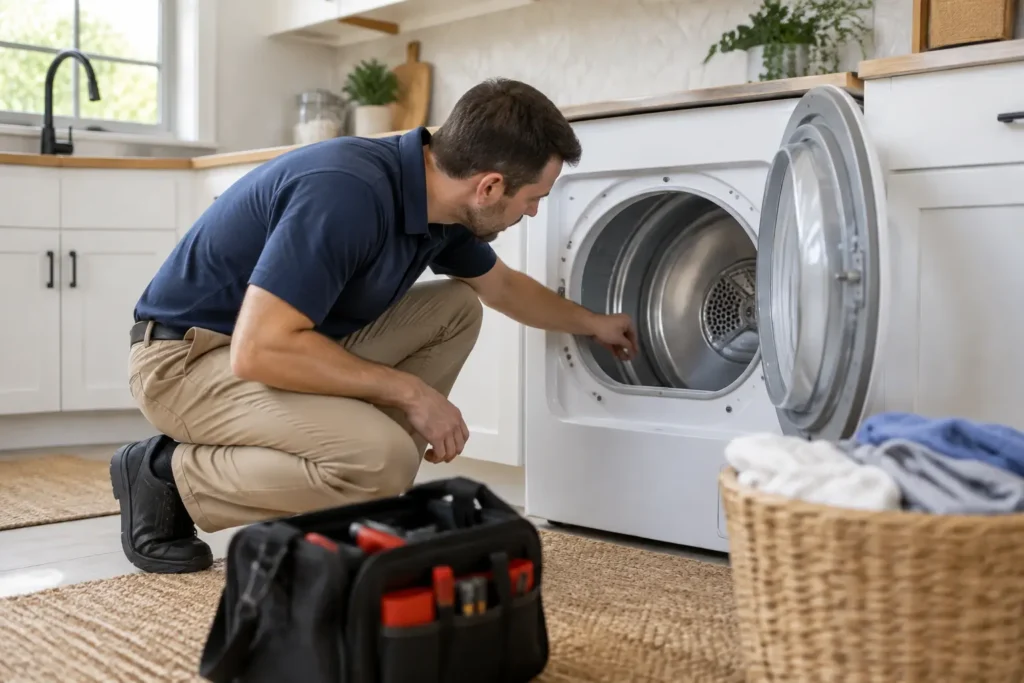
A dryer that suddenly gets loud can make an ordinary laundry cycle feel like a warning. Sometimes the cause is something simple, such as a zipper tapping the drum or a lumpy load. Other sounds can point to wear or a loose component that needs professional diagnosis. The sound alone cannot confirm which part is responsible, so focus first on safe observations rather than taking the machine apart.
If your dryer is noisy, stop the cycle and note what you heard and when it happened. A brief, light rattle may have a different explanation from a repeated thump, sustained squeal, or harsh scraping. If the noise is loud, worsening, or paired with a burning odor, stop using the dryer until it has been checked.
Start with the load and the drum
Turn the dryer off and let it cool before looking inside. If the plug is safely accessible, unplug the appliance before making these checks. Do not pull out a heavy dryer to reach the plug, and do not touch wiring or remove panels. If you cannot disconnect it safely, leave it off and contact a qualified appliance professional.
- Remove the laundry. Check for coins, buttons, clips, or other objects that may have been left in a pocket or caught in a garment.
- Look around the visible drum interior. With the dryer off and cool, check for an item resting at the drum edge or a garment caught near the opening. Do not reach into gaps or probe behind the drum.
- Consider the load. A single heavy item or a tangled bundle can tumble unevenly and knock against the drum. Redistribute the load and, only if there are no warning signs, try a small, balanced load while staying nearby.
- Check the machine’s position from outside. If it is safe to do so without moving the dryer, see whether it appears steady. Do not rock or reposition a connected appliance, particularly a gas model.
Use the timing and type of sound as clues
A repeating thump or bump that speeds up and slows down with the drum may be related to the load, an object, or a component that rotates. If it continues with an empty drum or a balanced load, arrange an inspection rather than repeatedly testing it. A squeal or high-pitched whine can have several possible causes, including wear in moving parts; it is not a reliable way to identify one specific part.
Scraping, grinding, or a metal-on-metal sound deserves particular caution. Stop the cycle and do not keep running the dryer to see whether the sound disappears. A loose item or a mechanical issue could worsen with continued use. A light rattle may come from something outside the drum, but if you cannot identify and safely remove its source without moving or opening the appliance, leave it for a professional.
Also notice whether the sound occurs only while the drum turns, at startup, or when the cycle ends. Write down the pattern, whether the dryer was full or nearly empty, and any recent change in performance. These details can help a repair professional narrow down what to inspect, without requiring you to guess at a diagnosis.
Know when to stop immediately
Stop the dryer and keep it off if you notice smoke, a burning smell, sparks, a damaged cord, unusual heat around the appliance, or a sound that becomes suddenly severe. Do not touch a hot or damaged cord, remove a panel, or try to test internal parts. If there is smoke or fire, leave the area and contact emergency services.
For a gas dryer, leave the area if you smell gas. Do not operate electrical switches, use a flame, or try to find the leak. From a safe location, contact your gas utility or emergency services as appropriate. Have a qualified professional assess the appliance before using it again.
When a service visit makes sense
Arrange service if the noise persists after you have checked the load and visible drum area, returns on an empty or balanced load, or comes with poor tumbling or other new symptoms. Avoid removing the cabinet or attempting repairs involving belts, motors, wiring, or internal supports. Even with the power disconnected, these components can be difficult to access safely, and gas connections should be handled by qualified professionals.
For households in Glendale and nearby communities, a repair professional can inspect the dryer and explain the likely cause and options before work is approved. You can learn more about dryer repair service or contact the business to ask about arranging an appointment. Until the cause is clear, do not run a dryer that is making a severe or worsening noise.