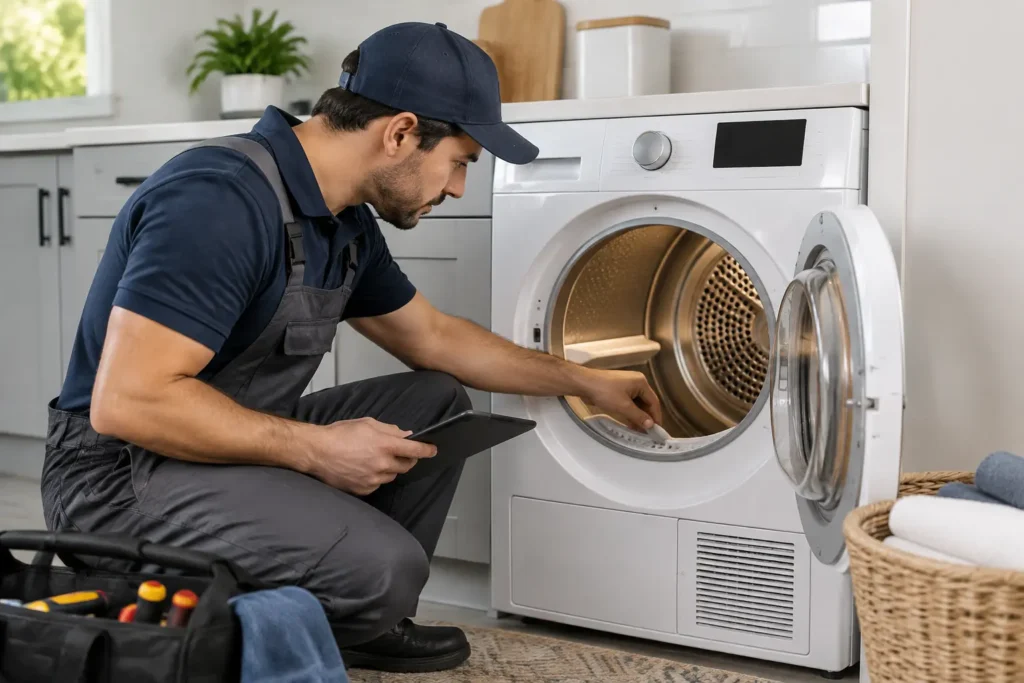
When a dryer stops working as expected, a few simple observations can help you decide what to do next. Is the drum turning? Does the load stay damp? Does the cycle end early, or does the appliance seem unusually hot? These clues can point to settings, airflow, or a fault that needs professional attention. Start with checks you can do without removing panels or reaching inside the machine.
Start with safety
Stop the dryer if you smell burning, see smoke or sparks, feel a shock or tingling, or notice unusual heat around the appliance or vent. Do not run it again to see whether the problem clears. If there is smoke or fire, leave the area and contact emergency services. For an electrical concern, avoid touching damaged cords, outlets, or the appliance; call a qualified professional.
If you smell gas near a gas dryer, do not use the appliance or operate nearby switches. Leave the area and contact your gas provider or emergency services from a safe location. Do not attempt to locate or repair a leak yourself.
For ordinary checks, follow the dryer manual. If you need to unplug the appliance, do so only when the plug and outlet are intact and safely accessible. Do not pull on the cord, move a heavy dryer by yourself, remove service panels, or work on wiring or gas connections.
If the dryer will not start
- Check that the door is fully closed and the cycle selector and start control are set as described in the manual. Some models require a button to be held briefly.
- Confirm that the control lock or delay-start setting is not active. A displayed lock symbol or countdown may explain why the cycle has not begun.
- Look for a visible power issue, such as a tripped breaker. If a breaker trips again after being reset once, stop and call a qualified professional rather than repeatedly resetting it.
- Notice whether the display is blank, shows an error code, or lights up without starting. Record the code and model information for service; avoid guessing at a reset procedure that is not in the manual.
A dryer that has power but will not start may have a door-sensing, control, or other internal problem. These components can require testing beyond safe homeowner checks.
If clothes are not drying well
First confirm that the selected cycle and temperature are suitable for the fabric and load. A low-heat or air-only setting can make a normal cycle seem ineffective. Avoid overloading: clothes need room to tumble, and a tightly packed load can dry unevenly. Very small loads may also tumble poorly in some models.
- Clean the lint screen as directed in the manual. If you use dryer sheets, follow the manufacturer’s instructions for keeping the screen clear of residue.
- Check that the exterior vent opening is not visibly blocked while the dryer is running, but do not reach into the vent or dismantle ductwork. If airflow seems weak or the vent is damaged, stop using the dryer until the restriction can be assessed.
- Consider whether the load began unusually wet. A washer that leaves clothes wetter than usual can make the dryer seem underpowered.
- Compare results across more than one appropriate cycle. If drying remains slow despite a reasonable load and a clean screen, an airflow restriction or appliance fault may need diagnosis.
Restricted airflow can contribute to overheating and longer drying times. Do not use the dryer when it becomes excessively hot, shuts off from heat, or gives a burning smell. Avoid running it unattended while you investigate a suspected vent problem.
If the drum turns but there is no heat
Check that the cycle is not set to air fluff or another no-heat option. If the setting is correct and the dryer still produces no heat, stop at that point. Electric and gas models use different systems, and internal heating, ignition, or control components are not safe to inspect without appropriate training. Do not remove panels or attempt to test live parts.
If the cycle stops or behaves inconsistently
Note whether the dryer stops at the same point, pauses only with a heavy load, or displays a code. Make sure the load is not tangled and that the door remains securely closed. If the appliance repeatedly stops, overheats, trips a breaker, or cannot complete a cycle, discontinue use and arrange an assessment rather than repeatedly restarting it.
What to note before requesting service
Write down the model number, the cycle used, what the dryer does, and any error code or unusual smell. Mention whether the drum turns, whether heat is present, and whether the problem began suddenly or gradually. This information can help narrow the next checks without replacing parts by guesswork.
If these basic steps do not resolve the issue, or a safety warning appears, consider scheduling a professional diagnosis. You can learn more about dryer repair service and request service when convenient. Avoid using the appliance until a suspected electrical, gas, overheating, or serious airflow problem has been addressed.